From 12 February 2028, economic operators who fill sales packaging must reduce empty space to the minimum necessary for the packaging’s function, including product protection (Article 24(4)). Unlike grouped, transport and e-commerce packaging, sales packaging has no fixed ratio. Paper, air cushions, foam and other fillers count as empty space. For products that settle or need headspace, compliance is judged at the time of filling.
Who this applies to: brand owners and co-packers that fill retail packs — cosmetics, toys, electronics, snacks, gift sets. Who it does not: the 50 % ratio for outer packaging is a separate rule (Article 24(1)) with a later date, and sales packaging used as e-commerce packaging is exempt from that 50 % rule but not from this one.
Two empty-space rules, two dates
| Sales packaging — Art. 24(4) | Grouped, transport, e-commerce — Art. 24(1) | |
|---|---|---|
| Applies from | 12 Feb 2028 | 1 Jan 2030, or 3 years after the methodology act, if later |
| Obligated party | The operator who fills the sales packaging | The operator who fills the grouped, transport or e-commerce packaging |
| Test | Minimum necessary for functionality, including product protection | Empty space ratio of at most 50 % |
| Empty space means | Total internal volume of the sales pack minus the volume of the product | Total volume of the outer pack minus the volume of the sales packaging inside |
| Fillers | Count as empty space | Count as empty space |
| Calculation method | None set; the guidance points to EN 13428:2004 | Implementing act due by 12 Feb 2028 |
| Exempt | — | Sales packaging used as e-commerce packaging; reusable packaging in a re-use system (Art. 24(5)) |
What counts as empty space
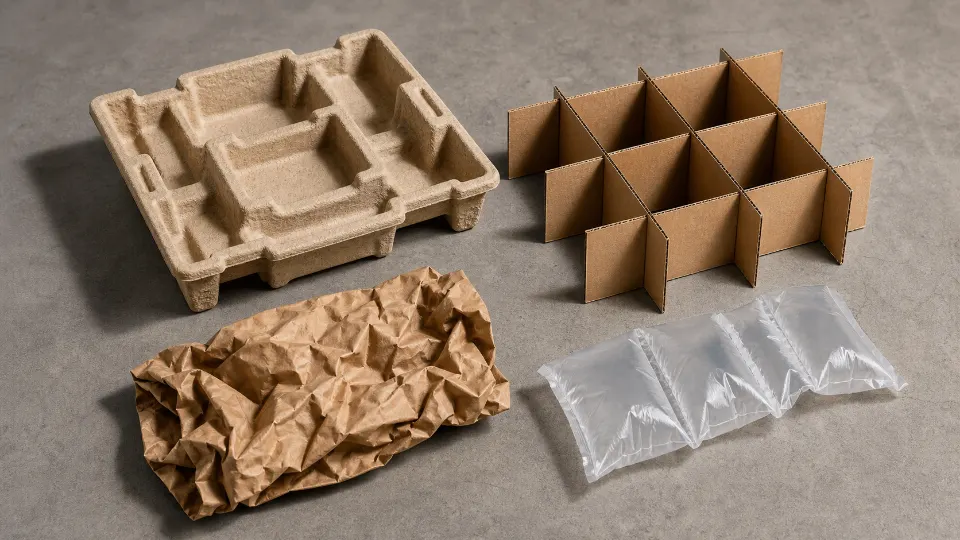
Article 24(4) lists filling materials that are treated as empty space: paper cuttings, air cushions, bubble wrap, sponge and foam fillers, wood wool, polystyrene or Styrofoam chips. Replacing air with filler does not help. An insert that holds the product in place may still be justified, but the justification is product protection, not volume.
Two adjustments apply to products that settle during transport or need headspace to protect food, and to other products with the same characteristics:
- compliance is assessed as the pack-fill level at the time of filling, not after settling;
- air between or within packed foodstuff, and protective gases, are not counted as empty space.
How Article 24(4) relates to Article 10
Article 10 requires the manufacturer to minimise packaging weight and volume by 1 January 2030, and bans features that only increase perceived volume — double walls, false bottoms and unnecessary layers — subject to limited design-right and geographical-indication exceptions. The Commission’s guidance treats the two together: for sales packaging there is no predefined threshold, so empty space is assessed using the existing minimisation standard EN 13428:2004 until updated performance criteria under Annex IV apply, and the manufacturer documents it in the technical documentation and EU declaration of conformity.
In practice the filler and the manufacturer are often the same company. Where they are not, the filler carries Article 24(4) and the brand owner carries Article 10, so both should share the same evidence.
Building the evidence
| Record | Why |
|---|---|
| Internal volume of each sales pack and volume of the product | The basis of the Article 24(4) comparison |
| Function of each component and insert | Shows which space is needed for protection, handling, information or legal requirements |
| Drop, compression or transit test results | Supports a claim that a smaller pack would damage the product |
| Fill level at filling, for settling or headspace products | The point at which compliance is measured |
| EN 13428 minimisation assessment | The reference method named in the Commission’s guidance |
What to do now
- Rank SKUs by empty-space share. Gift sets, cosmetics and toys usually top the list.
- Remove filler-only space rather than swapping one filler for another.
- Document the space you keep and the reason for it.
- Schedule changes before February 2028, and align them with label and recyclability updates so artwork changes once.
Frequently asked
Is there a maximum percentage for sales packaging?
No. The 50 % ratio applies to grouped, transport and e-commerce packaging. By 12 February 2032 the Commission must assess whether to set ratios for sales packaging, particularly for toys, cosmetics, DIY kits and electronics (Article 24(6)).
We ship our retail box as the parcel. Which rule applies?
Sales packaging used as e-commerce packaging is exempt from the 50 % ratio, but it must still meet Article 10 and, as sales packaging, Article 24(4).
Does modified-atmosphere gas count?
No. Protective gases, and air between or within packed foodstuff, are not counted as empty space.
Next: see the full minimisation picture on the requirements page, or check your packs in the checker.