From 12 August 2026, food-contact packaging cannot be placed on the EU market if it contains PFAS at or above 25 ppb for any single PFAS, 250 ppb for the sum of PFAS, or 50 ppm for total PFAS including polymers. The Commission recommends testing in three steps, starting with total fluorine: a sample below 50 mg/kg total fluorine can be considered compliant. There is no sell-off period for stock placed on the market after that date.
Who this applies to: anyone placing packaging that is intended to touch food on the EU market — paper and board with grease or water resistance, moulded fibre, bakery and fast-food wraps, trays, liners and coated cups are the usual exposure. Who it does not apply to: packaging with no food contact. Article 5(4) heavy-metal limits apply to all packaging regardless.
The three limits, and what each one actually measures
Article 5(5) sets three thresholds that must all be met. They are not alternatives; they catch different things.
| Limit | What it counts | Polymeric PFAS | How it is usually measured |
|---|---|---|---|
| 25 ppb (µg/kg) | Any individual PFAS | Excluded | Targeted PFAS analysis |
| 250 ppb (µg/kg) | Sum of targeted PFAS, with prior degradation of precursors where applicable | Excluded | Targeted analysis, e.g. after Direct TOP oxidation |
| 50 ppm (mg/kg) | All PFAS | Included | Total fluorine as a screen |
The third limit has a documentation hook: if total fluorine exceeds 50 mg/kg, the upstream manufacturer, importer or downstream user (as defined under REACH) must, on request, give the packaging manufacturer or importer proof of how much of that fluorine is PFAS and how much is not. That proof goes into the technical documentation under Annex VII.
The Commission's recommended test route
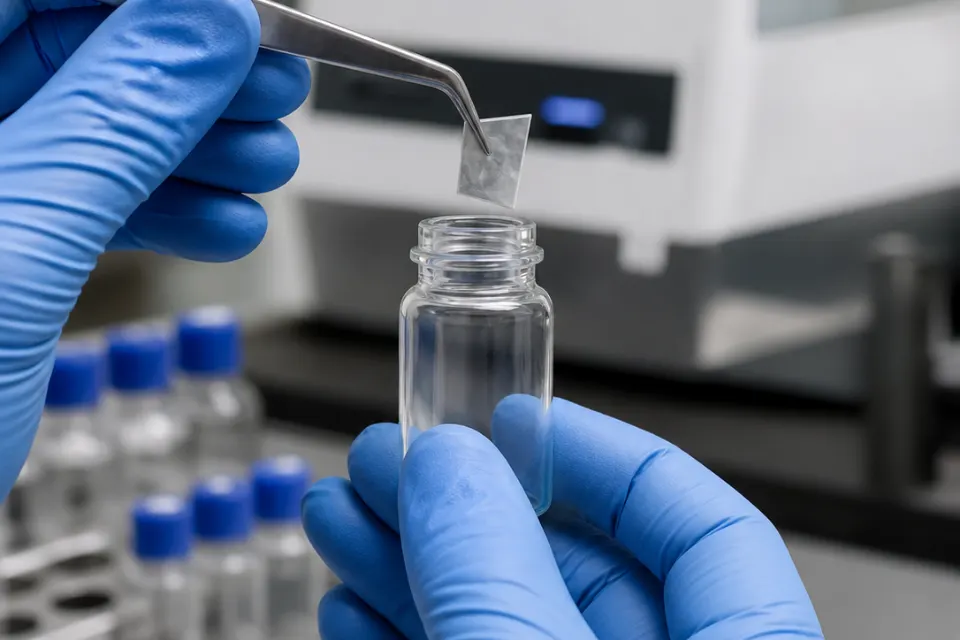
There is no harmonised EU method for PFAS in food-contact packaging. In its 2026 guidance the Commission recommends a stepwise approach that market surveillance authorities can use from the application date:
- Total fluorine (TF). If TF is below 50 mg/kg, the sample could be considered compliant.
- Organic or inorganic? If TF is above 50 mg/kg, a method such as pyrolysis-GC/MS can show whether the fluorine is organic (PFAS) or inorganic. Organic fluorine below 50 mg/kg: the sample could be considered compliant.
- Direct TOP analysis (total oxidisable precursors) to check the 25 µg/kg and 250 µg/kg limits.
“On the basis of the evidence currently available to the Commission, all samples compliant with test (1) are also compliant with tests (2) and (3).”
Commission guidance on Regulation (EU) 2025/40, section 5
In practice that makes total fluorine the cheapest useful first test. A low TF result settles the question for most uncoated or PFAS-free coated substrates; a high one tells you where to spend on further analysis.
Stock you already hold: no sell-off period
The guidance is explicit that the PPWR does not provide a transitional period for packaging containing PFAS that was produced before 12 August 2026. What matters is when the packaging was placed on the market:
- Placed on the market before 12 August 2026: may stay on the market, no withdrawal needed.
- Placed on the market after 12 August 2026: must meet the limits, regardless of production date.
- Packaging containing recycled material gets no exception.
The guidance also says when that moment usually is. Sales and grouped food-contact packaging are generally placed on the market when they are filled, because sealing can affect compliance; transport and service packaging are placed on the market empty. For imports, the relevant moment is release for free circulation at the end of the customs procedure.
Who enforces it
Market surveillance authorities under Regulation (EU) 2019/1020 check the PFAS limits, without prejudice to official food-contact controls under Regulation (EU) 2017/625. The limits apply only to the extent that another Union act does not already prohibit the packaging — so existing food-contact rules still apply in parallel.
What to do this quarter
- List every SKU where packaging touches food, including liners, labels on the food side and secondary wraps.
- Ask each supplier of coated or barrier-treated materials for a total fluorine result and, where above 50 mg/kg, the PFAS / non-PFAS split the regulation entitles you to.
- Commission total fluorine testing yourself where supplier data is missing or old.
- File the results in the technical documentation for each packaging type, alongside the EU declaration of conformity.
Frequently asked
Is this a PFAS ban?
Legally it is a set of concentration limits for food-contact packaging. The limits are low enough that intentional fluorinated grease-proofing will not meet them.
Does it cover non-food packaging?
No. Article 5(5) is limited to food-contact packaging. Wider PFAS restrictions are being handled under REACH, not the PPWR.
Is a supplier's “PFAS-free” declaration enough?
The regulation asks for evidence in the technical documentation. A declaration backed by a total fluorine result is far easier to defend than a declaration alone.
Next: see where PFAS sits among the other obligations in the requirement register, or run your pack through the checker with food contact pre-selected.